


Watch of the Week: IT: Welcome to Derry
-

- December 6, 2025
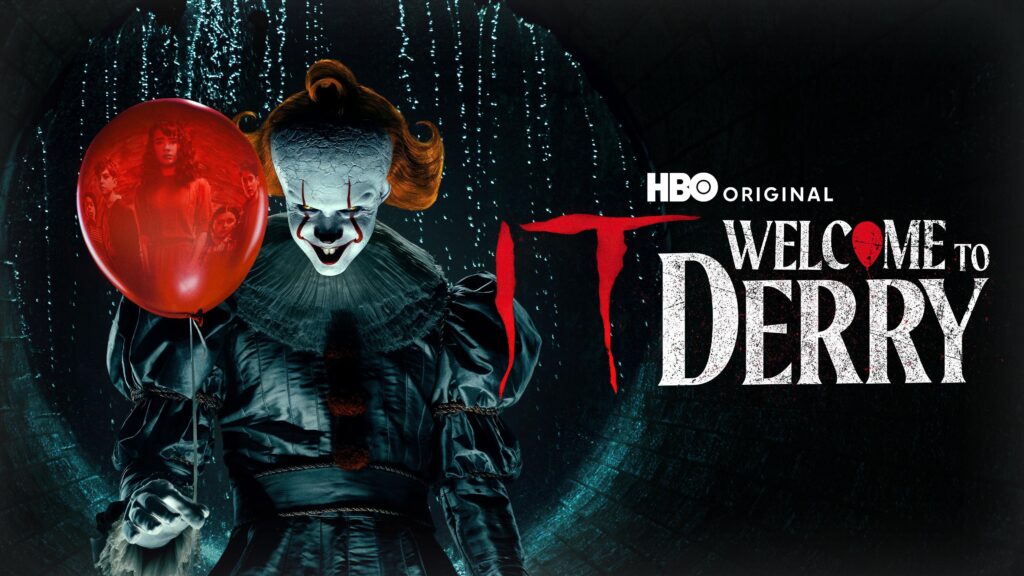
The title “It: Welcome to Derry” suggests a few things.
The new HBO Max series delivers on some of them. That it’s only some is not necessarily a bad thing.
The series is a prequel to It, the doorstop 1986 Stephen King novel that inspired two previous versions, one a TV miniseries with Tim Curry defining the evil clown Pennywise for the ages, the other a two-part theatrical release in 2017 and 2019, of which the first part was much better than the second.
Andy Muschietti, who directed the two theatrical films, created It: Welcome to Derry, along with his sister Barbara Muschietti and Jason Fuchs.
So, of course, you’d assume you’ll see Pennywise, which you do, eventually. (He’s played by Bill Skarsgård, reprising the role from the latter films.) And that you’ll learn what led to the events of the novel and the movies, which you also do, sort of.
The series, set in a Cold War-crazy 1962, opens with a boy named Matty (Miles Ekhardt) sneaking into a theatre to watch The Music Man. He’s caught and sent out. He gets picked up by a happy family and tells them he wants to go anywhere but home, anywhere but back to his dad.
It all seems pleasant enough, except when the daughter starts eating from a container of raw liver. Things get decidedly worse from there. Decidedly. It is truly one of the more disturbing scenes you’ll find in a TV series, even a horror one. Disturbingly entertaining, I should note. If you’re an It aficionado, you will recall that It, the monster that feeds on fear, returns every 27 years. And that it doesn’t have to take the shape of a clown.
After the title sequence, we meet more kids, Phil (Jack Molloy Legault) and Teddy (Mikkal Karim-Fidler) and Phil’s sister Susie (Matilda Legault). Then there is Loonly Lilly Bainbridge (An excellent Clara Stack), home from a stint in a psychiatric hospital after the death of her father in a pickle factory. The kids team up with Ronnie to try to figure out what happened to the missing Matty, after Lilly hears his voice through the bathtub drain — and his fingers reach out to her.
It’s a lot, yes, and we’re just getting started. Several of the characters are visited by nightmares, or nightmarish versions of their fears, much like in the films. Here they are especially terrifying. What’s more, Muschietti and the other creators are not averse to making some shocking decisions. Kill your darlings, the advice for writers, takes on a whole new meaning here.
That uncertainty only adds to the tension. And again, the series does not skimp on the gore.
Not everything works. Do we really need a long and detailed explanation for how It came to be? You might think so, but after this, you may rethink that notion.
What makes King’s writing so inviting is the communities he builds. It suffers from repetition as a novel, but we learn a lot (a lot) about the characters and their town. Here, either it’s assumed we know more, or character development was a casualty of the writing process. Either way, some characters are written pretty thin.
Luckily, the young actors are all engaging, making up for a lot of that. And if you like horror, it sounds as if horror would be self-evident in a horror series, but fans of the genre know it can be surprisingly lacking. It: Welcome to Derry won’t disappoint. At least not much.

Boluwatife Adesina is a media writer and the helmer of the Downtown Review page. He’s probably in a cinema near you.