

Movie Review: Crime 101
-

- February 28, 2026
It’s clear from the way Mike Davis meticulously collects his stray hair and dry skin in a tarp before he heads out on a job that he is not an ordinary criminal.
Sure enough, the opening scenes of Crime 101 follow Mike as he executes a daring but carefully organised heist. Mike is efficient and calculating but not violent. When something does not go according to plan, he stays calm and improvises his way through. He’s the sort of thoughtful thief who wears a ski mask and coloured contact lenses to disguise the one visible part of his face. When the LAPD shows up to investigate his latest crime, the detective on the case, Lou Lubesnick, almost sounds like he admires his suspect. “He’s got rules! And he sticks to ’em!” Lubesnick gushes to his sceptical partner.
Who could blame Lou for his enthusiasm? Everyone loves a film crook who creates his own set of rules and then sticks to ’em. Nevermind that stealing millions in diamonds from a jeweller breaks a pretty big societal rule in the first place; thieves like Mike Davis are fun to root for in movies. They appeal to ordinary viewers who follow the rules in their own lives and would never even contemplate executing a high-stakes robbery — but who like to think that if they did, they’d be like Mike: Smart, strong, tough (but not cruel), and extremely good at his job.
Mike sees himself as a sort of Robin Hood, taking from the rich to give to the poor (i.e. himself). That is a delusion, but it is a pleasant one to base a hard-boiled thriller around. And Crime 101 is thoroughly pleasant from top to bottom. It’s not the sort of procedural littered with gore and dead bodies. It’s about the joy of a consequence-free car chase, and the satisfaction of a well-executed plan that doesn’t involve too much collateral damage.
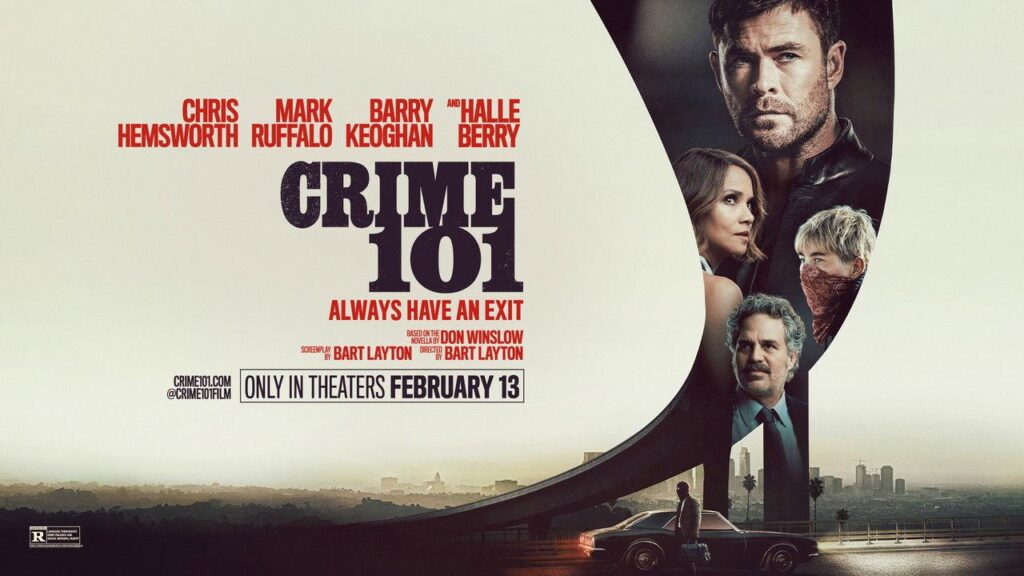
It does contain some pained attempts at subtext. The dialogue occasionally veers from the clipped speech patterns of stoic pros to Say Something Important about How We Live Now™. When LA cop Lou Lubesnick questions a woman tangentially related to the Davis case, within 90 seconds of their introduction he accuses her of trying to grab “a piece of the American pie” and she responds with an aphorism about how “every human interaction creates a pattern,” it’s like the two are having a conversation based entirely on things they read on inspirational desk calendars.
Then again, Crime 101 suggests a pattern of its own, one created by the long-running strain of crime fiction about the symbiotic relationship between cop and crook. This latest instance bears strong similarities to films like Heat and to TV shows like The Wire (2 of my all-time favourites!). At one point, two characters compare the merits of their favourite Steve McQueen film, Bullitt, and in a movie where people repeatedly question the nature of coincidences, it doesn’t feel like one that Crime 101 specifically calls out that title.
Some elements of Crime 101 feel like outright theft of earlier works, but of course, a thief like Mike Davis (Chris Hemsworth) would see no problem stealing from the likes of Michael Mann or David Simon. They’re exactly the kind of target Mike likes; the rich kind that’s well-insured and can afford a loss. Working with a grizzled old fence (Nick Nolte), Mike locates pricy jewels around Los Angeles, acquires inside information about weak points in their security, and then exploits those weak points as quickly and as safely as he can.
While Crime 101 is an action movie, the role is something of a departure for Hemsworth, whose typical hero is that of an almost literal god so supremely confident in their own abilities that they cannot concern themselves with mortal emotions like anxiety or disappointment. Mike still bears Hemsworth’s hulking frame and rugged jaw line, but he’s a constant bundle of nerves; eyes darting, fingers fidgeting, like he assumes there is someone waiting around every corner to arrest or kill him. Neurotic isn’t a type I’ve come to expect from Hemsworth, but he pulls it off surprisingly well here.
Living out of a suitcase in a series of rented furnished apartments, constantly switching cars, leaving no trace evidence of his crimes, Mike may be uncatchable — at least until he turns down a job that seems too risky. His inside man quickly replaces him with another criminal, played by Barry Keoghan, who is as chaotic as Mike is orderly, and whose reckless activities threaten to expose the entire scheme.
Meanwhile, Lubesnick (a rumpled and brooding Mark Ruffalo) draws closer to finally proving his theory that a string of robberies along the 101 freeway in Los Angeles (hence the film’s name) has been perpetrated by a single “Lone Ranger” — i.e. Mike. But unlike Mike, Lubesnick does not follow the rules, at least the unwritten ones that dictate that members of the LAPD’s Robbery Division care more about their clearance rates than actually solving mysteries.
Lou’s inquiries eventually lead him to the other key figure in this drama, an insurance salesman named Sharon, played by Halle Berry. She insured some of Mike’s stolen gems, and her company does not want to pay off the policy. Nor do they want to promote Sharon to partner, despite her seniority. That gives Berry a juicy supporting role to play as a middle-aged woman spurned by the boys’ club of corporate America. Repeatedly disrespected, Sharon slowly becomes another weak point for Mike to exploit as part of his crimes.
For a while, Mike, Lou, and Sharon proceed along parallel tracks, with enough moments where they unwittingly pass one another on freeways, and enough discussion of classic muscle cars to suggest Paul Haggis’ Crash could be another source of swiped inspiration. (Crime 101 is based on a Don Winslow novel.) There’s even a subplot sparked by a fender bender; after Mike gets rear-ended by a young Hollywood publicist (Monica Barbaro), sparks begin to fly, and Mike develops second thoughts about the ascetic existence he maintains in order to preserve his anonymity and safety.
The ways in which the characters keep passing one another only to become completely entangled in each other’s lives before a big finale require a fair amount of suspended disbelief. But the way screenwriter/director Bart Layton seamlessly shifts between the three interconnected storylines via invisible match cuts is slick and impressive. Layton also delivers several extremely taut robbery sequences, including a climactic one that’s a masterclass in squirmy suspense.
Crime 101’s car chases might not measure up to Bullitt, but they’re solid; good enough that the characters name-checking Bullitt onscreen isn’t a total embarrassment. A few clunky lines of dialogue aside, the movie mirrors the honourable thief at its centre: Methodical, cool, and effective.
7/10 it’s surprisingly fun

Boluwatife Adesina is a media writer and the helmer of the Downtown Review page. He’s probably in a cinema near you.